



The Affordability Ecosystem Behind Utility Arrears
By Carisa Woolstenhulme, Arrears Management Consultant | 4-minute read
Economic pressure changes the nature of collections work. During periods of economic disruption, including the Great Recession, the COVID-19 pandemic, and the recent inflationary period, utility arrears have often broader affordability pressures. In these conditions, past-due bills are rarely just about a missed payment. Economic hardship, unemployment, rising household costs and changes in customer assistance and disconnection policies have all influenced a customer’s ability to stay current on utility bills.
The Affordability Ecosystem
This is why arrears aren’t only a collections challenge. Arrears are a signal that something in the broader customer support ecosystem may not be working as well as it needs to. From the customer’s perspective, the experience can feel fragmented: one place to discuss a bill, another to request assistance, another to make payment arrangements, and still another to understand what happens next. Internally, utilities are working hard3 across billing, payments, assistance, collections, field operations, call centers, regulatory teams, and community partners, but customers often experience the gaps between those teams.
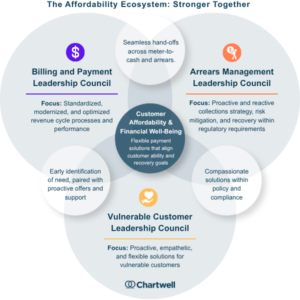
This interconnection is what we refer to as an Affordability Ecosystem. Meaningful progress and innovation happen when the right people are in the room together. Chartwell Leadership Councils are built on this idea. The Billing and Payment Leadership Council, Vulnerable Customer Leadership Council, and upcoming Arrears Management Leadership Council each approach affordability from a different angle, but the work is deeply interconnected.
As the Arrears Management Leadership Council is developed, discussions with utilities across the U.S. and Canada have focused on the arrears management, credit, and collections challenges they are navigating today. Those conversations highlighted the interconnected nature of cross-department policies, constraints, and view to examine how existing programs2 and how these areas influence one another.
Three Consistent Utility Themes
First, arrears management is no longer a single-process collections challenge1. It touches credit policy, payment arrangements, customer communication, digital tools, assistance referrals, regulatory rules, third-party collections, field activity, and measurement. The challenge is understanding how all of these pieces fit together in a coordinated strategy across many parts of the enterprise, including systems that are often in the process of large technology upgrades.
Second, payment arrangement3 flexibility continues to surface as a practical pressure point. Utilities may have standard arrangements available online or through customer service, but those structures do not always fit customers who are already struggling or who have broken prior arrangements. Many of the offerings are driven by regulatory rules. Customers need tailored solutions and better support to stay on arrangements. Utilities need clearer insight into which approaches reduce re-default while still supporting revenue recovery and aligning with regulatory requirements.
Third, utilities continue to see a gap between available assistance and customer awareness or access. Programs, payment support, agency funding, and community resources may exist, but customers often navigate multiple steps, eligibility rules, documentation requirements, timing issues, and handoffs. That creates friction for customers and operational complexity for utilities, especially when assistance, billing, collections, and external partners are not working from the same information at the same time.
The Customer View
Chartwell’s 2025 Residential Consumer1 study findings reinforce that affordability exists in an ecosystem, and customers are feeling the pressure. Nearly half the customers advised they feel more financially constrained, and over half would support their provider by offering new options like income-based rates or expanded bill assistance. Further, payment hardship is spreading across income groups, with between 6% and 9% of households in each income bracket experiencing a disconnection for nonpayment in the last year. With nearly 1 in 2 customers feeling the financial crunch, the gap becomes more apparent between the support they need and the support they believe their provider offers, with fewer than a third feeling their utility is doing enough to help those in need.
Beyond Identifying Arrears
For utilities, the opportunity is not just to identify customers who are behind. It is better to understand what is driving the arrears, where customers are getting stuck, and what interventions can make a difference before the balance becomes harder to resolve. That takes coordination and innovation across billing, payments, assistance, collections, customer care, field operations, community partners, and policy.
Join the Conversation
If these themes resonate with what you are seeing at your utility and you’re interested in participating, sharing your experience, or learning from peers, we invite you to fill out this form.
As part of the form, you can indicate your interest in:
- Contributing to the Arrears Management Benchmarking Survey
- Joining the July 30 working group discussion
- Attending future arrears management webinars
- Participating in the Arrears Management Leadership Council in-person council meeting in Atlanta on September 22
- Attending affordability-focused track sessions at the EMACS Conference
- Participating in an upcoming Voice of the Customer (VOC) call to help shape future council content, research, and discussion topics
The conversations taking place across the industry continue to highlight opportunities to share effective practices, identify areas for improvement, and explore innovations that are meaningful for both the customer and the utility.
We look forward to hearing your perspective and continuing the conversation.
1Requires Insight Center Membership | 2Requires Vulnerable Customer Leadership Council Membership | 3Requires Billing & Payment Customer Leadership Council Membership
***

Carisa Woolstenhulme brings over 20 years of utility experience across credit, collections, and customer operations. She is the founder of the Arrears Management Leadership Council at Chartwell Inc., where she helps utility leaders innovate on billing, payments, assistance, collections, customer care, field operations, community partners, and policy that improve the customer experience.
Previously, Carisa led Customer Credit Services at Salt River Project, where she managed accounts receivable for more than $3 billion in electric revenue while maintaining bad debt well below 1%. She is known for developing practical, customer-centered approaches to arrears management and affordability that balance customer needs with utility business objectives.
