




Workforce Continuity Is the Next Frontier in Utility Resilience
For years, utility resilience has focused on infrastructure, technology, emergency response, and cybersecurity. But as utilities face accelerating retirements, workforce shortages, and increasing operational complexity, another question has become impossible to ignore:
Who keeps the organization running when the people who hold its most critical knowledge aren’t available?
That was the focus of Beyond the Bench: Succession Planning and Workforce Continuity in Utility Resilience, featuring Victor Fleites, Principal Consultant at Chartwell, alongside Usman Rahman, Manager of Business Continuity and Emergency Management at Hydro One, and Corey Mulryan, Business Continuity Consultant at Exelon. Together, they explored how utilities can identify workforce-related resilience risks, strengthen succession planning, and ensure critical capabilities remain available when they’re needed most.
Critical Roles Aren’t Always Defined by Job Titles
One of the webinar’s central themes was the distinction between critical roles and critical individuals.
As Rahman explained, a job title alone doesn’t determine whether a position is essential. Instead, organizations should begin with a business impact analysis (BIA) that identifies the functions most critical to maintaining operations. From there, utilities can determine which roles support those functions and where risk exists if only one or two people possess the necessary expertise.
The discussion also highlighted an important reality: even highly critical functions become far less vulnerable when multiple employees are trained to perform them. Workforce resilience is as much about depth as it is about expertise.
Building a Bench, Not Just Naming a Backup
Traditional succession planning often focuses on identifying a single replacement for key positions. The panel argued that this approach is no longer sufficient.
Instead, organizations should intentionally build second- and third-tier talent through cross-training, role shadowing, exercises, and real-world experience. The objective isn’t simply to fill vacancies; it’s to ensure that someone can confidently step into a leadership or response role during a crisis.
Mulryan emphasized that identifying technically capable employees isn’t enough. Utilities should also consider an employee’s interest, engagement, and willingness to serve in emergency roles. People who understand their purpose, and want to contribute, often perform better under pressure.
Experience Can’t Be Replaced by PowerPoint
One of the strongest themes throughout the discussion was the value of practical experience.
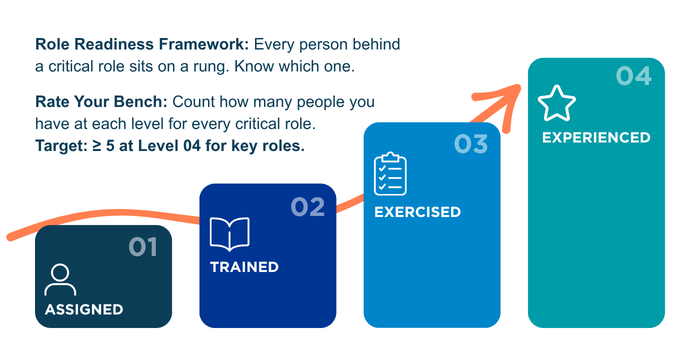
Hydro One has developed a role-readiness model that moves employees through four stages:
- Role assignment
- Targeted training
- Hands-on exercises
- Real incident experience
This framework allows the organization to measure readiness across its emergency response structure while identifying gaps before they’re exposed during an actual event.
Both Rahman and Mulryan agreed that simulations have limitations. Shadowing experienced personnel during actual incidents, or at least during live emergency operations, provides lessons that cannot be replicated in a classroom.
Knowledge Is the Asset Most at Risk
While utilities often focus on replacing positions, the panel noted that the greater challenge is preserving institutional knowledge.
Procedures, manuals, and playbooks capture explicit knowledge, but many of the decisions that keep utilities operating successfully rely on tacit knowledge, the judgment, intuition, and experience developed over years in the field.
As experienced employees retire, organizations risk losing that expertise unless deliberate knowledge-transfer strategies are in place. Shadowing, mentoring, documentation, and emerging AI-powered knowledge capture tools all have a role to play in preserving that expertise for future generations.
HR and Emergency Management Must Work Together
Another recurring theme was the need for stronger collaboration between Human Resources and resilience leaders.
Several panelists argued that emergency response responsibilities should no longer be treated as informal assignments. Instead, organizations should integrate emergency roles into hiring, development, training, and career planning.
Rahman described an organization where every employee understood they had both a “blue sky” role for normal operations and a “gray sky” role during emergencies. Embedding resilience responsibilities into workforce planning from the beginning creates greater clarity, accountability, and organizational readiness.
Workforce Continuity Is Becoming a Strategic Priority
The discussion concluded with a broader observation: resilience is expanding beyond infrastructure and technology.
Utilities now face a growing range of disruptions, from severe weather and cyber incidents to workplace violence, wildfires, and public health emergencies. Responding effectively requires organizations to develop adaptable workforces with the depth, flexibility, and authority to make critical decisions under pressure.
The greatest risk, the panel agreed, isn’t simply losing people. It’s losing the knowledge, experience, and decision-making capability that organizations depend on every day. Preparing for that reality requires workforce continuity to become an integral part of business continuity, emergency management, and enterprise resilience strategy, not just an HR exercise.
