



Turning Assistance Events into Real Financial Relief
By Heather Siebken – Director, Councils & Marketing
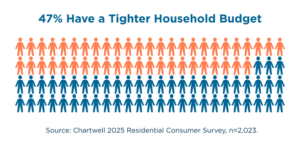
Customer affordability has become one of the most important priorities for utilities, not as a short-term issue but as a sustained operating reality. And customers are highly sensitive to affordability as well; Chartwell’s 2025 Residential Consumer Survey reported 47% percent of consumers agreed or strongly agreed that their household budget was more constrained in 2025 than in 2024.
Across the industry, utilities are expanding support programs, strengthening community partnerships, and increasing visibility into available assistance.
Customer assistance fairs and resource events are strong examples of that effort in action, as discussed recently in April’s Vulnerable Customer Leadership Council call. They bring services directly into communities, create access points for customers who may not engage through traditional channels, and help connect people to programs they might not otherwise know about.
The intent behind these efforts is clear: Make affordability support more accessible and more human.
The opportunity now is to make them more consistently effective.
From awareness to completion is where the real value sits
Most affordability programs are well-designed and widely available. The challenge is not the existence of support; it is the step between awareness and successful enrollment or resolution.
Customer assistance events sit right at that critical point. They are often the moment when customers are most open to engaging in support options, but the outcomes depend heavily on how the experience is structured. Learn more about LADWP’s Support Saturdays by watching this past webinar.
When these events focus primarily on information sharing, they create awareness and connection. When they are designed to support completion, enrollment, payment arrangements, or account stabilization, they create an immediate financial impact for customers.
Both matter, but they are not the same.
From activity to outcomes is where measurement becomes meaningful
Most utilities already track participation in assistance programs, but fewer are consistently measuring energy assistance outcomes end-to-end, in other words, from initial engagement at events through to enrollment completion, payment stabilization, and sustained bill support.
This is where Energy Assistance Metrics become critical. Instead of treating success as attendance or inquiries, leading utilities are starting to measure:
- Completion rates from event engagement to program enrollment
- Time from first contact to financial assistance activation
- Reduction in arrears or payment delinquencies post-enrollment
- Repeat contact rates for customers who attended events
Without these metrics, it’s difficult to understand whether events are creating awareness or actual financial relief.
The shift: From outreach events to resolution environments
The most effective utilities are evolving how they think about these events. Rather than treating them solely as outreach or education opportunities, they are designing them as resolution environments – places where customers can move from issue to solution in a single interaction.
This shift is subtle but important. It changes the goal of the event from “help customers understand what is available” to “help customers complete what they need.”
In practice, that means:
- Reducing the steps between eligibility and enrollment
- Supporting real-time decisions rather than follow-up actions
- Connecting customers directly to the right program based on their situation
- Embedding support through trusted community partnerships so assistance is accessible where customers already are, not requiring them to seek it out
When that happens, affordability support becomes more immediate and more tangible for customers.
Why this matters beyond the event itself
The impact of effective affordability engagement extends well beyond the event day.
When customers successfully enroll in support programs or establish payment plans, it often reduces downstream strain across the system:
- Fewer repeat billing and payment inquiries
- Reduced likelihood of account escalation
- More stable payment behavior over time
- Lower burden on collections and customer service teams
In that sense, these events are not just community engagement; they are part of the broader affordability operating system. PSEG does an excellent job discussing the full 360-degree approach to serving customers during the May 2025 Vulnerable Customer Leadership Council meeting call.
And when they work well, they create value for both customers and utilities at the same time.
Chartwell’s POWERING FORWARD Brief
If you’re looking to strengthen the impact of customer assistance events, the opportunity is to build more consistency around completion and not just participation.
Specifically:
- Design for action, not just information: Structure events so customers can enroll or resolve issues on the spot, not just learn about options
- Simplify the path to support: Reduce documentation and process friction wherever possible during the event experience
- Focus outreach on the right customers: Use billing and usage data to prioritize those most likely to benefit
- Close the loop after the event: Ensure any unresolved customer needs are actively followed up on until completion
The goal is not to change the intent of these events; it is to strengthen the connection between effort and outcome.
Customer assistance events are already playing an important role in how utilities support affordability. The next step is making sure that role consistently translates into real financial relief for customers; quickly, clearly, and with as little friction as possible.

The Vulnerable Customer Leadership Council discussed outreach events and resource fairs in April and will continue with energy assistance and payment solutions in May. Contact Tim Herrick to learn more about the agendas and the speakers. If you believe you are serving your most vulnerable customers in a way that exemplifies delivering best-in-class results, consider applying for an Excellence in Serving Vulnerable Customers Award. It’s free to apply, and a great opportunity to be recognized for the impact you’re making.
***
 Heather Siebken is a product and marketing leader and customer experience expert with more than 25 years of experience driving innovation, customer engagement, and strategic growth. She currently leads councils and marketing at Chartwell, where she designs industry forums and content that help utilities establish a customer experience strategy to navigate customer expectations and digital transformation.
Previously, Heather led product development and marketing at Omaha Public Power District, where she oversaw a broad portfolio of customer energy solutions spanning energy efficiency, demand response, electrification, and customer assistance programs. She is known for her strategic foresight, storytelling, and ability to translate complex trends into actionable business outcomes.
