



Targeted Marketing Starts With Understanding Your Business Customers
By John Bord, Customer Experience Consultant | 3-minute read
Business customers may all receive electricity from the same utility, but they don’t all need, or expect, the same experience.
That was the focus of June’s Business Customer Leadership Council meeting2, where members explored how utilities can strengthen relationships with small and midsize businesses (SMBs) through customer segmentation, targeted communications, and collaboration between marketing and account management teams.
SMBs are often treated as a single audience, yet a restaurant, medical office, manufacturer, and retailer all have different energy needs and business priorities. Leading utilities segment customers2 by factors such as industry, business size, energy usage, growth potential, digital preferences, and program participation. This allows communications to be more relevant, timely, and actionable instead of relying on broad, one-size-fits-all messaging. Hawaiian Electric Company highlighted this approach through its commercial client services model, sharing how the utility connects SMB customers2 with dedicated support, digital tools, and resources designed to help businesses access information, services, and solutions that meet their needs.
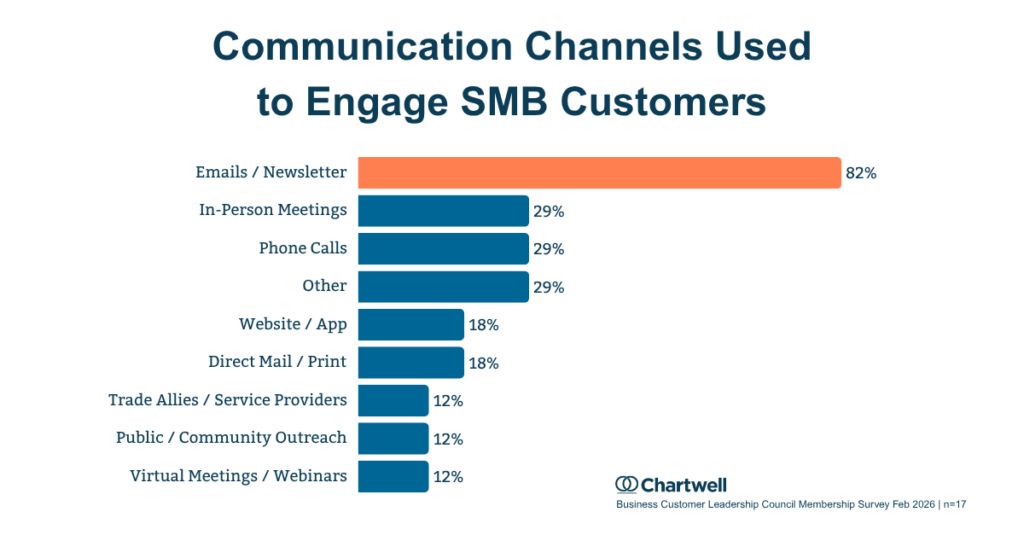
Rather than communicating only when programs launch, many utilities develop annual communication calendars that align messaging with seasonal needs and coordinate outreach across email, web, social media, bill messages, direct mail, and account managers. Planning ahead creates more consistent customer experiences while improving internal coordination and campaign effectiveness. A survey taken ahead of the recent Business Customer Leadership Council meeting call shows that utilities are primarily using emails and newsletters as a source of communication.
Successful business engagement depends on close collaboration. Marketing teams create consistent messaging and educational content, while account managers personalize conversations, explain programs, coordinate planned outages, and build trusted relationships with customers. Together, they create a more seamless customer experience.
Liz Pratt and Josh Scott of LG&E and KU recently presented to our Business Customer Leadership Council how collaboration between communications and business account management2 helps utilities build stronger relationships with small and midsize business customers. Their approach combines customer segmentation, targeted messaging and a “surround sound” communications strategy that uses multiple channels, including digital communications, community outreach and direct engagement to deliver timely, relevant information. Business account managers serve as trusted energy advisors, providing personalized support on reliability, energy programs, rates, and business needs, while communications teams create consistent messaging and resources to support those conversations.
Utilities that understand their customers, personalize communications, and coordinate outreach across departments are better positioned to strengthen relationships, increase program participation, and earn long-term trust. Check out this resource2, which covers the benefits of targeted communications to business customers, suggested engagement strategies, and more!
1Requires Insight Center Membership | 2Requires Business Customer Experience Leadership Council Membership
***

John Bord is a customer experience and marketing leader with more than 25 years of experience helping organizations better understand customer needs and improve the customer journey. He currently supports the Customer Experience and Business Customer Leadership Councils at Chartwell Inc., where he contributes insights on persona development, journey mapping, multicultural marketing, internal culture, and training initiatives and offers consulting services.
Formerly with Tucson Electric Power and Salt River Project (SRP), John led Voice of the Customer, customer insights, segmentation, and targeted marketing initiatives for residential and business customers. His work included customer journey mapping, analytics, and engagement strategies designed to better understand customer needs, reduce friction and improve experiences, and better serve diverse customer segments.
