



Energy Assistance Programs: A Critical Tool for Preventing Disconnections
By Pat Ricks, Vulnerable Customer Consultant | 4-minute read
A missed utility payment can quickly escalate into mounting arrears and the risk of disconnection. As affordability pressures persist across North America1, energy assistance programs have become one of the most important tools utilities rely on to manage customer debt and prevent service interruption at scale.
Across the industry1, nearly every major utility now operates some form of assistance program to help their vulnerable customers1. Yet the presence of a program does not automatically translate into meaningful customer impact.
Energy assistance programs are designed to deliver direct bill relief to customers in arrears and reduce outstanding balances to prevent disconnections2. In practice, however, outcomes vary widely in terms of adoption, mitigation, and results.
Chartwell’s analysis highlights both the scale of utility investment and the challenge of translating that investment into customer awareness. In a previous Chartwell webinar1, Austin Energy, SMUD and Entergy discussed how structured low-income assistance programs are being used to help customers manage growing utility debt. Entergy alone cited $10 million in bill payment assistance, underscoring the significant financial commitment utilities are making to affordability support.
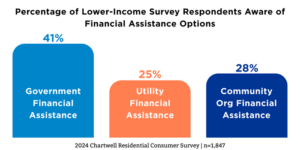
Despite investments like these, Chartwell’s 2024 Residential Customer Survey1 reveals a persistent disconnect between program availability and utilization. Only 25% of low-income respondents reported awareness of financial assistance programs offered by their utility.
The gap extends beyond bill assistance programs. While many utilities also offer energy efficiency programs1 designed to help customers reduce long-term energy costs, only 10% of low-income respondents reported participating in these programs. More strikingly, 51% were unaware whether their utility even offered such programs at all, despite their potential to lower monthly bills and improve long-term affordability.
Taken together, these findings point to a broader structural issue: utilities are investing in assistance and affordability programs, but a significant portion of intended benefit is not reaching customers in practice.
This raises a critical industry question. If energy assistance and related affordability programs are among the most powerful tools utilities have to prevent disconnections, why is adoption still so limited?
Increasingly, utilities are being evaluated not just on whether they offer assistance programs, but on how effectively those programs translate into reduced arrears and improved bill stability and fewer disconnections.
The leading utilities are treating energy assistance programs not as peripheral customer benefits, but as core infrastructure within their arrears management strategy2 directly tied to financial outcomes and service continuity performance.
Chartwell’s ‘Put it into Practice’ Brief
Utilities should take the following actions immediately to strengthen the impact of their energy assistance programs:
- Integrate assistance into arrears operations: Ensure energy assistance programs are a standard, first-line resolution within collections and arrears workflows.
- Set clear performance targets for program impact: Define measurable goals for how assistance should reduce balances and prevent disconnections.
- Align funding with outcomes: Evaluate whether assistance dollars are being deployed in ways that directly improve payment stability and reduce repeat arrears.
- Monitor program utilization gaps: Compare eligible customer volume against actual program participation to identify where assistance is not reaching intended populations.
- Hold programs accountable for disconnection reduction: Treat avoided disconnections as a primary KPI for energy assistance program effectiveness, not just dollars distributed.
Energy assistance programs remain one of the most powerful tools utilities have to manage affordability challenges. Their full value is only realized when they are operationalized as a core arrears management function that delivers measurable reductions in debt, instability, and disconnections at scale.
Check out these related resources2 from the Vulnerable Customer Leadership Council:
- Investments, Rates and Affordability Strategies
- Customer Support After Disconnect for Non-Payment
- Customer / Company Funded Assistance Program Workshop
- Innovative Payment and Credit Policies for Vulnerable Customers
- The Vulnerable Customer Toolkit
1Requires Insight Center Membership
2Requires Vulnerable Customer Leadership Council Membership
***

Pat Ricks is a customer service and market research leader with more than 36 years of experience. He currently supports the Vulnerable Customer Leadership Council at Chartwell Inc., where he facilitates peer collaboration on topics including regulatory trends, arrears management, access to government resources and innovative payment and assistance solutions.
Previously, Pat held a variety of leadership roles across operations, engineering, integrated energy management, account management, smart grid strategy, customer research and customer experience at Entergy where he developed and executed strategies designed to improve service delivery and strengthen assistance offerings for vulnerable customers. He is known for building practical, customer-centered solutions that balance customer needs, operational realities and business objectives.
