




Building Resilience Through External Stakeholder Engagement
In today’s high-stakes utility environment, resilience is no longer defined solely by the strength of physical assets or the sophistication of response plans. It is increasingly defined by the quality of an organization’s relationships and how effectively those relationships are activated under pressure.
Recent discussions within Chartwell’s Organizational Resilience Executive Council (OREC) underscore a clear reality: external stakeholder engagement is not a courtesy function or a communications add-on. It is a core resilience capability that directly influences restoration speed, regulatory outcomes, investor confidence, and public trust. Utilities that treat engagement as secondary often discover its importance too late, when decisions slow, friction rises, and reputational risk escalates.
To capture and codify these insights, OREC recently published a Guideline on external stakeholder engagement – a practical, experience-based reference designed to help utilities translate peer lessons into repeatable practices before, during, and after major events.
Major events demand coordination across a complex external landscape, including regulators, government agencies, emergency services, community leaders, customers, and critical partners. When these relationships are underdeveloped or poorly defined, utilities face avoidable challenges precisely when time and clarity matter most. OREC members consistently emphasize that effective engagement must be built before a crisis – not improvised during one.
Across OREC discussions, high-performing organizations demonstrate several common characteristics in how they approach external stakeholder engagement. First, they prioritize engagement where risk and influence are highest. Not all stakeholders carry equal weight during an incident, and engagement capacity is finite. Leading utilities intentionally tier stakeholders, focusing their attention on those who can most directly affect operational outcomes, regulatory response, or public perception.
Second, these organizations embrace controlled transparency. Rather than withholding information until certainty is achieved, they proactively educate stakeholders about what is known, what is unknown, and how updates will be shared. This approach builds credibility and reduces speculation when information is incomplete or evolving.
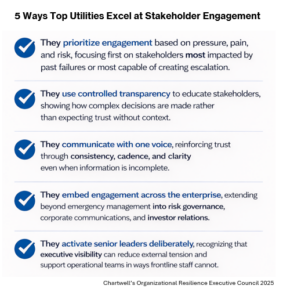
Of critical importance is the discipline of “One Voice” communications – the practice of aligning messaging across the enterprise to ensure stakeholders receive consistent, timely, and accurate information, regardless of channel or spokesperson. As Chartwell Executive Resilience Advisor Carlos Torres succinctly puts it: “Tell them what you know, tell them what you don’t know, and get back to them as you know what you didn’t know.” Applied consistently, this principle reinforces trust even amid uncertainty.
Read about one utility’s unified “one voice” communications approach: Data-Rich Web Platform Modernizes Emergency Response Capabilities at LUMA Energy
Another differentiator is enterprise-wide ownership. Effective engagement is not siloed within communications or regulatory teams. It is embedded across operations, emergency management, legal, customer experience, and executive leadership. Senior leaders play an active role in stakeholder engagement, particularly during high-consequence events, helping to reduce external tension and accelerate alignment.
OREC members also highlight the importance of treating stakeholder mapping as a living process. External dynamics change – new risks emerge, leadership shifts, and expectations evolve. Organizations that routinely revisit and update their stakeholder landscape are better positioned to respond decisively when conditions change.
Finally, exercises matter – not just as internal preparedness tools, but as opportunities to practice engagement under realistic conditions. Utilities that intentionally include external communications and stakeholder coordination in exercises report stronger relationships, clearer expectations, and fewer surprises during real-world events. In these organizations, exercises are not box-checking activities; they are resilience multipliers.
The message is clear: structured, prioritized, and transparent stakeholder engagement is foundational to organizational resilience. Utilities that embed these practices into everyday operations – not just crisis playbooks – move faster, coordinate more effectively, and protect trust when it matters most. In an environment defined by uncertainty and scrutiny, resilience is demonstrated not only by how well systems perform, but by how effectively leaders engage the stakeholders who matter most.
To learn more about the Organizational Resilience Executive Council, please contact Tim Herrick.
You may also like these blog posts:
- Why Crisis Communications Is the New Core of Utility Resilience
- Organizational Resilience: Defining, Governing, and Measuring for Strategic Impact
- Navigating Regulatory Expectations: Aligning Compliance, Communication, and Continuous Improvement
