


Six Ways Utilities Can Turn IVR Into a Better Customer Experience
By Stacey Bailey, Vice President
Customers expect utility interactions to match the speed, transparency, personalization, and self-service ease they experience in other industries—especially during outages or high-bill events—so IVR is no longer just call routing; it is a frontline digital experience that requires continuous improvement and active customer feedback.
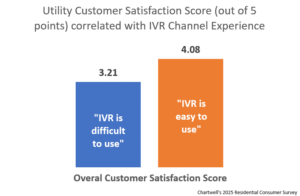
Utilities’ IVR performance increasingly shapes customer satisfaction as shown in the graph below which reflects a positive correlation between customers’ perceived IVR ease of use and overall customer satisfaction with the utility.
Below are six key takeaways from Chartwell’s recently published report, IVR Excellence: A Pathway To Operational Efficiency and Customer Loyalty.
1) Expanding and unifying self-service functionality is a primary lever for better CX and lower cost-to-serve. Most utilities now support common tasks like balance checks and payments, but leading programs are pushing further into more complex workflows (e.g., payment arrangements and service transfers) and aligning automation across channels so customers receive consistent, accurate information and achieve higher first contact resolution.
2) Treating IVR as a strategic digital product—integrated with core platforms—drives measurable results. Evergy’s approach of moving IVR ownership to the digital experience team, consolidating data sources, and doubling automated capabilities improved containment (67%) and reduced call volume by one million calls since 2020, illustrating how governance, roadmap alignment, and system integration translate directly into operational efficiency.
3) Clear, concise, mutually exclusive menu design—and high audio quality—remain foundational best practices. Top-performing IVRs reduce friction by using simple wording, short prompts, distinct choices, and strong error-recovery (e.g., an “oops” option), combined with consistent voices and well-paced recordings; these details improve comprehension, increase completion and containment, and reduce premature transfers to agents.
4) Real-time, “one voice” outage communications across channels are critical for public safety and trust. PG&E improved outage experience by replacing static IVR logic with real-time information from a unified platform and centralizing notifications, which increased notification delivery (55% to 94%), improved accuracy (+11%), and raised customer transaction scores for outages (6.0 to 7.6 out of 10).
5) Flexibility, personalization, and accessibility features are becoming differentiators in IVR performance. While touchtone still dominates, higher-performing systems more often support dual modality (press-or-say) with fail-safe fallbacks, and leading utilities pair personalization (recognizing callers and tailoring journeys) with inclusive design (e.g., consistent English/Spanish experiences) to improve containment and reduce abandonment.
6) Sustained IVR excellence requires disciplined measurement and continuous optimization. High-performing programs track and regularly review containment, abandonment, completion, and customer satisfaction—often supplemented by after-call surveys, usability testing, and call listening—to identify friction and focus improvements; because ease of use consistently aligns with higher CSAT, analytics-led, customer-centric design becomes the clearest path to long-term digital transformation.
If IVR optimization is on your utility’s roadmap, Chartwell’s Customer Experience Leadership Council discusses strategies such as those above to enhance the IVR customer experience. Additionally, utilities that are Chartwell members are eligible for a complimentary 1-hour personalized consultation by Chartwell partner, IVR Doctors, to uncover ways to optimize IVR performance. To schedule a consultation, contact info@ivrdoctors.com.
Read more about the Chartwell CX Council.
You may also like these blog posts:
- Understanding What Residential Utility Customers Need Most
- Closing the Gap: Optimizing Utility Customer Self-Service in a Digital Era
- Chartwell Debuts 2025 Consumer Perspectives on Utility Service and Customer Experience
Related Insight Center research:
