



From Plan to Performance: A Practical Operating Framework for Business Continuity
Business continuity programs often fail for a simple reason: they are treated as documentation instead of an operating capability. In a real disruption, no one is graded on how complete the binder is. Teams are judged on whether essential work continues, payroll, customer operations, regulatory reporting, fuel procurement, governance decisions, and the many behind-the-scenes functions that keep a utility (or any critical service) functioning.
That challenge is only getting harder. Disruptions are longer, more interconnected, and increasingly shaped by external dependencies, cloud platforms, telecom carriers, SaaS tools, and critical vendors. Meanwhile, executive and regulatory expectations continue to rise. The takeaway: Continuity must be designed to run under pressure, not merely to exist on paper.
A Practical Operating Framework reframes business continuity around execution. It answers the questions leaders and operators actually face: Who owns decisions? What functions are truly critical? What triggers activation? How do we coordinate with incident command, IT recovery, and communications? And how do we prove, through training and measurement, that the program will work when it counts?
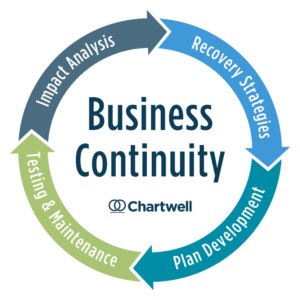
- Governance & ownership (clear authority, sponsorship, and decision rights)
- Risk assessment & business impact analysis (critical functions, realistic recovery objectives, dependency mapping)
- Continuity strategy & planning (workarounds, staffing contingencies, scenario-based strategies)
- Activation & integration (triggers, escalation paths, alignment with incident management structures)
- Training, testing & exercising (realistic reps, cross-functional participation, vendor inclusion)
- Lessons learned & continuous improvement (after-action discipline, governed updates, metrics over time)
The most valuable part of the framework is that it exposes execution gaps early. If your recovery time objectives rely on “best case” assumptions, the business impact analysis will show it. If teams don’t know when continuity activates, or how it fits with incident response, Activation & Integration will surface the friction before a real event does. And if lessons learned are captured but not governed to closure, continuous improvement turns that into a measurable, repeatable cycle. This framework is discussed in more detail in Chartwell’s recent paper, Defining Business Continuity as an Operational Discipline of Modern Utilities.
If you want continuity to be credible, start small and operational: pick a handful of critical functions, validate dependencies, run a short scenario exercise, and track the fixes to completion. Practical continuity is built the same way resilience is earned, through clear ownership, repeated execution, and proof.
Read more about the Chartwell Utility Resilience Institute.
You may also like these blog posts:
- Business Continuity Isn’t a Binder on a Shelf – It’s an Operational Capability
- 6 Communication Lessons Utilities Have Learned from Major Events
- Building Stronger Utility Resilience Through Effective Vendor Management
