



How Utilities Are Using AI and Automation: From Call Quality to Claims Resolution
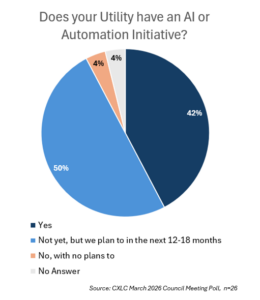
Artificial intelligence and automation are moving from “interesting pilot” to everyday utility operations. In Chartwell’s Customer Experience Leadership Council’s recent March meeting, participants shared a telling snapshot: 42% of council members said they’re already using AI in some capacity, and about half are considering implementation within the next 18 months. That’s a noticeable shift from late 2024, when about half reported they were not using AI at all.
One high-impact area is the customer contact center, where AI is helping leaders see what’s happening across thousands of conversations without manually reviewing a tiny sample. Connexus Energy described using an AI-powered quality assurance tool (Capacity) that scores calls across key moments, opening, call handling, and closing, and provides dashboards, real-time reporting, and a coaching hub for one-to-ones. The team uses conversational topic search to surface emerging issues (for example, payment-arrangement questions tied to cold weather rules) and to identify recurring barriers that lead to repeat calls, supporting the ongoing push for better first-call resolution.
Importantly, these programs are not “set it and forget it.” Speakers emphasized the need to refine scoring logic over time, adding new phrases and context as teams discover gaps, and to balance automation with human review. Connexus continues to manually evaluate selected calls for items that may be out of scope for automated scoring, such as nuanced process adherence or how an agent’s tone lands with different customer segments.
Beyond the contact center, utilities are applying automation to complex back-office workflows. DTE Energy shared a pilot in electric damage claims where an “AI Genie” workflow pulls data from roughly 17 different systems, assembles a preliminary investigation report, and recommends next steps, turning a process that could take hours to create a ticket and days (even up to 30) to investigate and resolve into minutes. Early pilot results cited productivity improvements of more than 75%, faster customer responses, and fewer escalations and follow-up disputes because decisions are backed by clearer, more consistent evidence.
Hydro One highlighted a similar theme with a tool called Call Journey, which analyzes customer conversations for sentiment, trends, and recurring words or phrases. The goal is to spot call drivers early, like billing-related spikes during a postal strike, or detect issues before they escalate, such as questions about outage restoration times. These insights can be fed directly into targeted coaching (for example, identifying when agents need more training on online account password setup), while still keeping formal quality audits in place for scorecards.
Taken together, these examples show where utilities are getting traction: using AI to listen at scale, automate repetitive investigations, and deliver faster, more consistent outcomes, without removing humans from the loop. As adoption grows, the practical lessons are clear: start with a measurable pain point, invest in tuning and governance (especially security and data integrity), and pair automation with the right checkpoints so trust rises alongside efficiency.
Read more about the Chartwell CX Council.
You may also like these blog posts:
- How Strategic Workforce Planning Can Dramatically Reduce Contact Center Wait Times
- Six Ways Utilities Can Turn IVR Into a Better Customer Experience
- Understanding What Residential Utility Customers Need Most
Related Insight Center research:
