



Transforming the High Bill Experience: Lessons From a Customer Journey Mapping Exercise
As utilities focus more intentionally on customer experience, one area consistently ripe for improvement is the high‑bill journey. During a recent workshop, representatives from Chartwell’s Customer Experience, Billing and Payment, and Vulnerable Customer Leadership Councils came together to rethink how a financially stressed customer—represented by “Evelyn”—navigates a high‑bill situation. The result was a powerful reminder of how thoughtful design, empathy, and cross‑functional collaboration can fundamentally reshape customer outcomes.
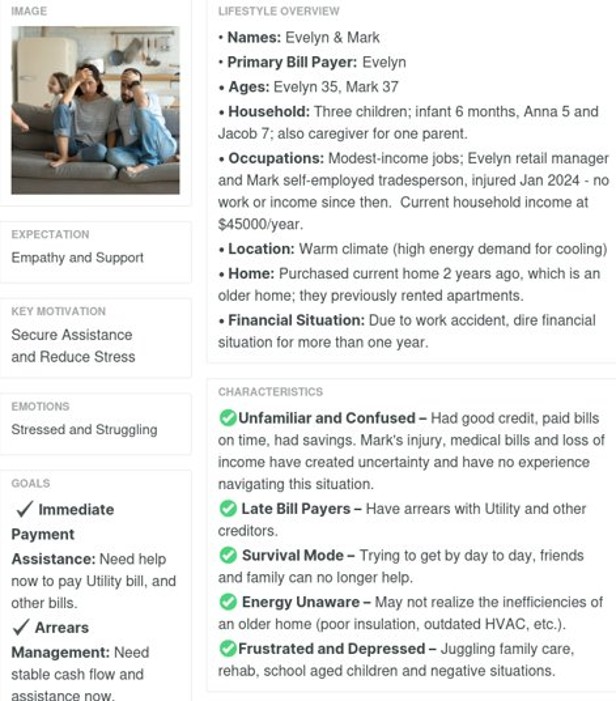
The exercise began with a clear challenge: Evelyn receives an unexpectedly high electric bill at a time when her family is under severe financial strain. Her current‑state journey, mapped through workshop feedback, revealed predictable pain points—long hold times, confusion about charges, distrust of digital tools, and emotional stress tied to shame and uncertainty. These friction points are not unique; they mirror what many vulnerable customers experience across the industry.
By contrast, the future‑state journey imagined by the councils showcased what a low‑effort, high‑empathy experience could look like. It begins well before the high bill arrives, with proactive alerts, a thoughtful welcome kit, mobile app setup, and personalized thresholds. When Evelyn does seek help, an IVR predictive message routes her directly to a trained customer advocate—someone equipped not only with billing knowledge but with social care expertise focused on empathy.
Throughout the journey, the advocate provides clear explanations, conducts usage and rate analyses, summarizes next steps by email, and coordinates follow‑ups. Community partners play a role too, offering resources beyond the utility’s offerings—food support, job counseling, energy audits, and more. The experience culminates in a final check‑in call that reinforces trust and closes the loop.
👉 Turn customer insights into meaningful care – Customer Experience Journey Mapping Workshops for Residential and Business Customers: High Bill Customer Journey
This redesigned journey doesn’t simply resolve a high bill; it transforms a moment of crisis into an opportunity to strengthen loyalty, reduce arrears, and demonstrate genuine care.
Journey mapping is inherently collaborative. It requires cross-functional input and validation from customers themselves. Start by defining objectives, reviewing VOC data, and developing personas that reflect real motivations and expectations. Then, create a current-state map to diagnose issues and a future-state map to design ideal experiences. This iterative process ensures continuous improvement, guided by governance models and refreshed with ongoing VOC insights.
The benefits are significant. For customers: personalized, consistent service and faster resolution. For utilities: operational efficiencies, cost savings, and stronger loyalty. Journey maps also inform product innovation, marketing strategies, and decision-making at scale.
Journey mapping is not static. It starts with a current-state map to identify pain points, then evolves into a future-state map that reimagines the ideal experience. This process requires cross-functional collaboration and customer validation to ensure accuracy. Over time, maps should be revisited and refined based on Voice of Customer (VOC) insights.
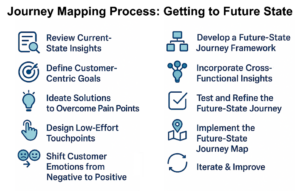
By combining detailed steps, emotional analysis, and collaborative input, journey maps transform raw data into actionable strategies – improving processes, enhancing customer satisfaction and trust, and driving operational efficiency.
Need help from Chartwell? We offer cost-effective Advisory Services on all aspects of journey mapping – from persona development and facilitated journey mapping sessions to train-the-trainer programs to align your organization. For more information, please contact John Bord, Senior Consultant, at jbord@chartwellinc.com.
Read about the Vulnerable Customer Leadership Council.
You may also like these blog posts:
- Arrearage Burdens: A Growing Challenge for Utilities and Customers
- Navigating Change: Three Key Trends Shaping the Utility Industry
Utility Customer Research – Insight Center:
