



From Arrears to Action: Four Pillars for Next-Gen Utility Credit & Collections
Utility arrears remain elevated, even among customers with historically strong payment behavior, forcing leaders to rethink credit and collections as a strategic, customer-centric capability. In a recent Chartwell webinar, panelists from Chartwell’s Billing and Payment and Vulnerable Customer Leadership Council outlined a practical framework built around four pillars: proactive engagement, next-gen success metrics, empowered employees, and smart technology.
Why the urgency? The panel framed arrears management as both a financial-health issue, cash flow supports reliability and grid investment, and an equity issue. When delinquency rises, costs can shift to customers who pay on time. At the same time, households are squeezed by broader affordability pressures, making “business as usual” collections approaches less effective and more harmful.
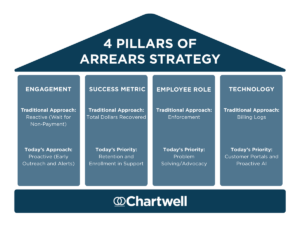 Pillar 1: Move from reactive to proactive. Don’t wait for a missed payment to start a conversation. Use early signals and simple tools, like high-bill alerts, bill projections, and targeted reminders, to help customers anticipate what’s coming and act before balances snowball…and just offering the tool isn’t enough; utilities also need to promote it, so customers know it exists before they need it.
Pillar 2: Redefine success. Traditional measures like write-offs still matter, but they’re backward-looking. The panel urged adding forward-looking metrics tied to customer retention: sustainable payment-plan adoption and completion, assistance-program awareness and enrollment, and disconnection avoidance. The goal shifts from “dollars recovered” to “neighbors kept connected”, with payment arrangements that fit real household cash flow.
Pillar 3: Empower employees as problem-solvers. Collections teams can’t succeed alone. Speakers highlighted cross-functional collaboration (credit, billing, customer care, marketing, community partners), plus specialized advocacy teams and case-management models for complex situations. That requires training, time to handle sensitive calls, and a culture that gives employees “permission to pivot” from enforcement to help.
Pillar 4: Leverage technology and data. Automation can remove friction (for example, routine order workflows and balance transfers), while machine learning models can improve risk identification and prioritize outreach. The best examples paired analytics with action, dashboards that guide agents to the right conversation, and digital pathways that speed assistance approvals, so technology supports both financial resilience and a more seamless customer experience.
The throughline across all four pillars is early intervention with dignity: spot risk sooner, offer clear options, measure what keeps customers stable, and equip teams with the tools and authority to help. If you’re looking for one “tomorrow morning” step, start by mapping who is most likely to slip into arrears and coordinating outreach across departments, before the customer hits an insurmountable crisis.
Ultimately, next-gen collections are less about tougher policies and more about better pathways: clearer communication, easier self-service, and faster connections to the right assistance or arrangement. Utilities that align outreach, metrics, staff enablement, and analytics around customer financial health will be better positioned to reduce arrears, strengthen trust, and keep more households safely connected.
Read about the Billing and Payment Leadership Council.
You may also like these blog posts:
- From Crisis to Care: How Utilities Are Rethinking Arrears Management
- Mobile Wallets and Autopay Lead Utility Payment Initiatives
- How Digital Outreach Is Rewriting Arrears Management
Insight Center Utility Customer Research:
