



How Utilities Manage Major-Event ETRs
By Russ Henderson – Director of Research
Estimated times of restoration (ETRs) are a longstanding challenge for utilities. That challenge becomes significantly more difficult during major events, when widespread damage, limited visibility into field conditions, shifting restoration priorities, and rapidly changing circumstances introduce a high degree of uncertainty. Automated systems that perform well during routine outages often become less reliable at scale, forcing utilities to rely more heavily on field intelligence, operational judgment, and cross-functional coordination. As a result, providing timely and credible ETRs during major events remains one of the most complex and visible responsibilities in outage communications.
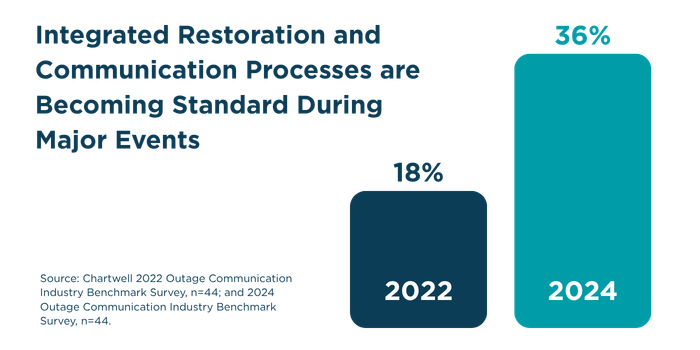
Chartwell’s Outage Communications Leadership Council has published a new guideline, Estimated Times of Restoration During Major Events, based on discussions during the council’s April 2026 meeting. The report explores one of the most persistent challenges in outage communications: How utilities deliver timely and credible ETRs when widespread damage and uncertainty make automated estimates less reliable.
The guideline was informed by presentations from Alabama Power (case study)and Omaha Public Power District (case study), both recognized in Chartwell’s 2026 Best Practices Awards for innovations related to ETR management and emergency response. Their experiences highlighted a broader industry shift: ETRs are no longer treated as static system outputs but as an actively managed process requiring dedicated roles, field intelligence, and strong governance.
The guideline examines practical strategies utilities are using to improve ETR performance, including ETR monitors and coordinators, “progress over perfection” communication, global estimates followed by progressive refinement, and continuous post-event improvement. It also emphasizes the critical role of field crews as the most trusted source of restoration information.
As major events become more frequent and complex, the ability to provide accurate and transparent ETRs remains central to customer trust. This guideline offers outage communications professionals a practical roadmap for strengthening one of the most visible and consequential aspects of storm communications.
Read more about the Chartwell Outage Communications Leadership Council.
You may also like these blog posts:
