



Why Utilities Need a Major Public Event Playbook
When a city hosts a major public event, whether it’s locally planned or designated as an NSSE or SEAR, utilities are suddenly operating in a spotlight. The operational environment tightens: timelines are externally driven, partners multiply, interdependencies rise, and the tolerance for service disruption drops to near zero. In that moment, technical performance and organizational reputation become inseparable.
Chartwell’s Organizational Resilience Executive Council recently designated a Working Group and partnered with Prestige Analytics to create a Major Public Event Playbook that utilities can customize and use to prepare for Major Events. The Playbook is not a standalone operational plan, and it doesn’t replace existing procedures; instead, it provides a customizable, disciplined framework for event-focused planning. By establishing clear governance, accountability, and decision authority, while still preserving flexibility to adapt in real time, the Playbook reduces uncertainty and helps utilities align internal teams with external agencies around a unified operational posture.
The Working Group organized the Playbook across the full lifecycle—Pre-Event, Event-Time, and Post-Event—the Playbook is built around nine core sections. Sections 1–8 are developed in parallel to define executive intent and “no-fail” objectives, set leadership and decision rights, design command and coordination, prioritize risks, tier critical services and interdependencies, build a time-based readiness roadmap, establish an event-time operating cadence, and validate readiness through exercises. Section 9 then captures lessons learned and converts them into measurable resilience improvements.
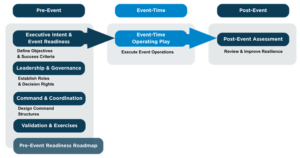
The list below outlines each section of the playbook:
- Executive Intent and Event Readiness: Defines the event’s purpose, establishes executive intent and “no-fail” objectives, identifies key operational distinctions, and sets success metrics that anchor accountability and guide all subsequent planning and execution.
- Leadership, Governance and Decision Rights: Offers guidance for establishing an event-specific governance structure, including defining leadership roles, delineating decision-making authorities, identifying escalation thresholds, and clarifying responsibilities across internal and external stakeholders.
- Command, Control, and Coordination: Outlines the guidance on designing the coordination and command structure for the event period, including how to align with incident management frameworks, activate operational centers, integrate with partner agencies, and implement communication protocols across all phases of an event.
- Risk Priorities and Readiness Strategy: Guides users in identifying and prioritizing event-related risks and developing readiness strategies and mitigation measures to address those risks.
- Critical Service Priorities (Tiering and Interdependencies): Provides guidance for determining which services, facilities, and assets should be prioritized during the event, and offers instruction on identifying interdependencies and defining protection and restoration requirements.
- Pre-Event Readiness Actions and Roadmap: Contains guidance on developing a time-based readiness roadmap that outlines all required actions, milestones, and resource preparations, including system hardening, maintenance surges, staffing plans, and equipment staging necessary to reach full operational readiness before the event.
- Event-Time Operating Play (Executive Operations Runbook): Provides guidance for event-time management, including operational cadence, situational awareness practices, reporting rhythms, decision triggers, surge resource activation, escalation pathways, and action planning activities throughout the event.
- Validation Program: Guides users in defining and executing a pre-event exercise and validation program that evaluates organizational readiness, confirms operational assumptions, and confirms that planned capabilities function as intended.
- Post-Event Assessment and Resilience: Provides guidance on conducting a structured post-event assessment, capturing lessons learned, evaluating performance against objectives, and implementing corrective actions to strengthen long-term organizational resilience.
Each section ends with an outcome product supported by structured supplements and templates so leaders can formally document readiness and maintain executive oversight. The result is a practical, repeatable way to deliver reliable, safe, and coordinated service when expectations are highest.
For more information about Chartwell’s Organizational Resilience Executive Council or this Playbook project, please reach out to Tim Herrick therrick@chartwellinc.com.
You may also like these blog posts:
- From Plan to Performance: A Practical Operating Framework for Business Continuity
- Business Continuity Isn’t a Binder on a Shelf – It’s an Operational Capability
- 6 Communication Lessons Utilities Have Learned from Major Events
