



Machine Learning for ETR: What Utilities Learned on the Auto ETR Journey
By Stacey Bailey, Vice President
Estimated Time of Restoration (ETR) has long been one of the most challenging—and most visible—promises utilities make to customers during outages. A recent Chartwell Outage Communications Leadership Council working group discussion brought together utilities at different stages of their Auto ETR journeys to compare notes, surface lessons learned, and explore what it really takes to move from static estimates to machine learning-driven predictions.
👉 Council member resource: Working Group Call – Machine Learning for Estimated Times of Restoration
One theme was universal: customers care deeply about getting an estimate, quickly, even if it later changes. Several utilities emphasized that the absence of an ETR often hurts customer satisfaction more than an estimate that turns out to be conservative, an observation backed up by data from Chartwell’s Tranzact post-event evaluation study, shown in the graph below.
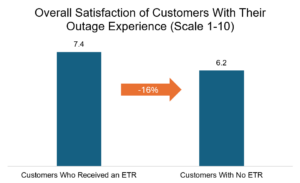
This insight has pushed organizations to focus not only on accuracy but also on speed, transparency, and expectation setting. Participants shared how early Auto ETR efforts often start simply, using static averages based on historical outage durations, and then evolve into more dynamic models. Machine learning allows utilities to incorporate variables such as time of day, number of customers affected, outage type, and regional workload. Interestingly, multiple teams noted that adding more features does not always improve results; in some cases, fewer, higher-quality inputs produced more reliable predictions.
Another key takeaway was the importance of operational controls around the model. Rather than running Auto ETR in a fully “hands off” mode, leading utilities use centralized control panels to manage delays, apply regional overrides, and adjust behavior during storms. This balance between automation and human judgment helps maintain trust with both customers and field crews.
Finally, success depends as much on people as on technology. Utilities that gained early traction often did so because operations teams saw Auto ETR as a way to reduce manual data entry and keep crews focused on restoration. Over time, ETRs became not just a customer communication tool but also a performance benchmark, encouraging teams to restore power as fast, or faster, than historical norms.
You may also like these blog posts:
