




Building Stronger Utility Resilience Through Effective Vendor Management
In today’s rapidly changing utility environment, vendors have become essential partners in building and sustaining emergency management readiness. As utilities face increasingly complex challenges—from major storms to evolving cybersecurity threats—external partners now support critical functions such as damage assessment, situational awareness, logistics, analytics, and customer communications. This shift elevates vendor management from a basic procurement activity to a strategic discipline.
A key theme emphasized in the latest Emergency Management Leadership Council Guideline is that strong vendor relationships must begin well before an incident occurs. Emergency managers, who regularly identify cross-departmental operational gaps, play an important role in turning real-world challenges into credible business justifications. Whether identified through After Action Reports, exercises, or regulatory requirements, clearly defining the problem before seeking potential solutions remains a foundational best practice.
Council members can download it in its entirety: Guideline No. 10 – Vendor Management
Once a need is recognized, utilities frequently encounter complex approval and budgeting pathways involving operations, IT, finance, procurement, legal, and emergency management. Achieving stakeholder alignment and clarifying funding models—whether operational, capital, or disaster activation-based—can significantly influence timelines and overall success.
Vendor selection itself extends far beyond comparing features. Many utilities now emphasize system integration capabilities, long-term flexibility, surge scalability, cybersecurity maturity, and alignment with enterprise technology roadmaps. Several organizations caution against adopting narrow point solutions that address immediate pain points but create long-term integration challenges.
Even after contracts are signed, implementation becomes a crucial validation phase. Phased deployment, clear activation roles, realistic maturity expectations, and inclusive training ensure solutions perform under real-world conditions. Rushed rollouts—especially ahead of major event seasons—can introduce unnecessary operational risk.
Long-term vendor management is an ongoing commitment.
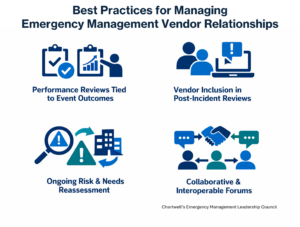
Regular performance reviews, inclusion in post-incident analysis, and periodic reassessment allow utilities to evolve alongside changing hazards and organizational needs. Some utilities even convene multi‑vendor technology summits to improve collaboration and interoperability—strengthening resilience across the ecosystem.
Ultimately, deliberate vendor management empowers utilities to expand capacity, reduce friction during activations, and build durable partnerships that enhance emergency response and recovery.
Read more about the Emergency Management Leadership Council.
You may also like these blog posts:
- The Impending Snowstorm: A Live Stress Test for Utility Alignment
- Excellence in Business Continuity Planning and Execution Award
- Building Resilience Through External Stakeholder Engagement
