



Fix the Friction, Fuel the Loyalty: Journey Mapping as a Catalyst for Business Customer Delight
Customer Journey mapping is a strategic framework for driving meaningful change. Mapping the customer journey helps utilities uncover pain points to reduce effort, highlight moments of delight, and identify opportunities for growth.
A journey map begins with the high-level stages of the customer’s interaction: investigation, contact, resolution, and reflection. Beneath these stages are the micro-steps customers take, such as calling support or waiting on hold. Capturing these details, along with timestamps and durations, provides clarity on where friction occurs.
Explore the Insight Center report: Mastering Journey Mapping: Your Guide to Designing Exceptional Experiences
For example, in a scenario recently mapped on a monthly meeting of Chartwell’s Business Customer Leadership Council, Chris, a hardware store owner facing a power outage, the map begins with his investigation: “Is the issue on my side? Is it the breaker? Do neighboring businesses have power?” It then moves through contacting the utility, waiting for updates, and making operational decisions – stay open or close the store. Each action is documented with timestamps and duration, such as a 75-minute outage and five minutes on hold, and each step carries effort and emotion, which should be measured and visualized.
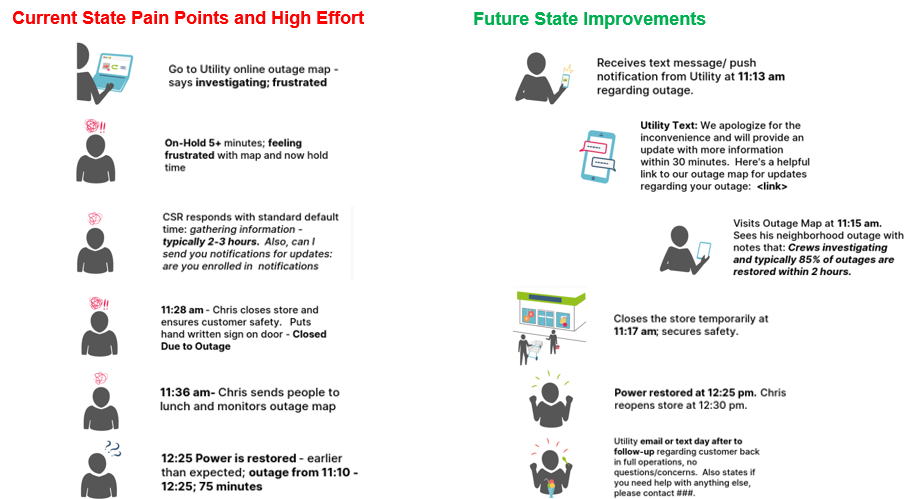
Effort rankings typically use a 1–5 scale, while emotions range from negative to positive. This dual analysis reveals gaps – often wide – between what customers feel and the effort required. The goal: low effort, high positive emotion.
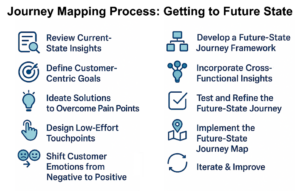
Journey mapping is inherently collaborative. It requires cross-functional input and validation from customers themselves. Start by defining objectives, reviewing VOC data, and developing personas that reflect real motivations and pain points. Then, create a current-state map to diagnose issues and a future-state map to design ideal experiences. This iterative process ensures continuous improvement, guided by governance models and refreshed with ongoing VOC insights.
The benefits are significant. For customers: personalized, consistent service and faster resolution. For organizations: operational efficiencies, cost savings, and stronger loyalty. Journey maps also inform product innovation, marketing strategies, and decision-making at scale.
Journey mapping is not static. It starts with a current-state map to identify pain points, then evolves into a future-state map that reimagines the ideal experience. This process requires cross-functional collaboration and customer validation to ensure accuracy. Over time, maps should be revisited and refined based on Voice of Customer (VOC) insights.
By combining detailed steps, emotional analysis, and collaborative input, journey maps transform raw data into actionable strategies – improving processes, enhancing customer satisfaction and trust, and driving operational efficiency.
Need help from Chartwell? We offer cost-effective Advisory Services on all aspects of journey mapping – from persona development and facilitated journey mapping sessions to train-the-trainer programs to align your organization. For more information, please contact John Bord, Senior Consultant, at jbord@chartwellinc.com.
To learn more about the Business Customer Leadership Council, don’t hesitate to reach out to Tim Herrick.
You may also like these blog posts:
- Chartwell Releases 2025 Digital Experience Benchmarks Report
- Business First, Gold Standard: PSEG Long Island Honored for Customer Excellence
- Customer Experience Journey Mapping Workshops for Residential and Business Customers: High Bill Customer Journey
Related Insight Center research:
