




Could Mutual Aid Solve Contact Center Demand During a Crisis?
By Heather Siebken, Director, Councils & Marketing | 2.5-minute read
A major outage can mobilize hundreds of utility employees, contractors, and crews across organizational and geographic boundaries. Mutual assistance has become a well-established part of utility resilience, allowing organizations to share resources when the scale of an event exceeds what one utility can manage alone.
But what happens when the greatest strain goes beyond the electric system?
A widespread outage, severe weather event, major billing issue or cyber incident can generate an extraordinary surge in customer contacts. Call volumes increase. Digital channels become congested. Social media activity accelerates. Customers need updates, reassurance, and assistance all while utility employees are managing the operational response.
Many utilities have established plans for restoring infrastructure during major events. Far fewer have a comparable strategy for scaling customer support when demand exceeds available staff.
Customer experience is often treated as a downstream function of emergency response: Operations restore service, communications share information and customer service handles the resulting questions. During a major event, however, these functions become deeply interconnected and the challenge is having the right capabilities available at the right time.
Traditional overflow strategies are often designed for predictable increases in volume. A major event is different. It can produce an immediate, sustained, and highly emotional demand spike that requires specialized knowledge of utility operations, customer communications, crisis response, and the customer experience.
That raises an intriguing possibility: What if utilities could share customer experience resources during extraordinary events, just as they share restoration crews?
The concept raises important questions. What roles could be shared? How would employees be trained before an event occurs? What information and systems would they need access to? How would utilities protect customer data? Who would manage the resources? And how would participating organizations establish governance, cost-sharing, and activation criteria?
These aren’t reasons to dismiss the concept. They are the operational questions that need to be solved before a model can work at scale.
Chartwell’s POWERING FORWARD BRIEF
The most valuable time to determine how additional customer support will be mobilized is before the phones start ringing.
- Stress-test customer capacity. Model demand and staffing needs during major events.
- Identify critical roles. Determine which customer-facing functions are most likely to become constrained.
- Run a tabletop exercise. Test how customer demand could be managed alongside the operational response. Bring customer experience, communications, operations, and emergency management leaders together and test assumptions, identify gaps, and determine what would actually be required to share resources during a real event.
- Define the guardrails. Address training, system access, data protection, governance, and activation requirements.
- Start small. Explore a pilot with a defined scenario and a small group of utility partners.
Mutual assistance has demonstrated for decades that utilities don’t have to face extraordinary challenges alone. Extending that mindset to customer experience could create a new layer of organizational resilience, one designed around the people who need support when a high-impact event affects their lives.
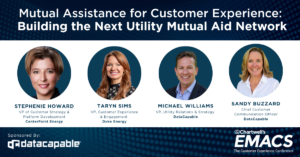
Intrigued? Want to explore what this could actually look like? Join us at EMACS, where Michael Williams and Sandy Buzzard of DataCapable will partner with CenterPoint Energy‘s Stephenie Howard to lead a tabletop exercise exploring how utilities can turn the concept of Mutual Assistance for Customer Experience into a practical, scalable model.
***

Heather Siebken is a product and marketing leader and customer experience expert with more than 25 years of experience driving innovation, customer engagement, and strategic growth. She currently leads councils and marketing at Chartwell, where she designs industry forums and content that help utilities establish a customer experience strategy to navigate customer expectations and digital transformation.
Previously, Heather led product development and marketing at Omaha Public Power District, where she oversaw a broad portfolio of customer energy solutions spanning energy efficiency, demand response, electrification, and customer assistance programs. She is known for her strategic foresight, storytelling, and ability to translate complex trends into actionable business outcomes.
