




Beyond the Medical Registry: Rethinking Support for Medically Dependent Customers
By Heather Siebken, Director, Councils and Marketing
For most customers, a power outage is an inconvenience. For customers who depend on electricity to power essential medical equipment, it can become a health and safety emergency.
The population affected is significant. Approximately 14.5 million U.S. households report having medical devices that require electricity to operate, according to the U.S. Census Bureau. Nearly one-third of those households, 31.6%, experienced a power outage during the year measured.
Identification is only the beginning
Medical registries provide an important foundation. They help utilities understand where medically dependent customers are located and can support planning during outages and emergencies.
But enrollment alone does not create resilience. A customer’s needs can change. Contact information can become outdated. Equipment requirements can change. A customer may have a backup generator2, but still need assistance during an extended outage. And a customer who was fully prepared for a short interruption may face very different circumstances when an outage stretches into the night or continues for multiple days.
Research reinforces why duration matters. A study of U.S. power outages between 2018 and 2020 identified 17,484 outages lasting eight hours or more, a duration the researchers characterized as medically relevant because of its potential health consequences. That suggests utilities should think about medically dependent customer programs not simply as a registry, but as an ongoing preparedness and resilience strategy.
The customer journey is more than an outage
It is tempting to think about medically dependent customers primarily through the lens of outage management. But the experience begins much earlier.
A customer may first learn about a utility’s program through a healthcare provider, social service organization, utility employee or community partner. They then may need to understand eligibility requirements, complete documentation, provide medical information and keep that information current.
Each step creates an opportunity for friction. A customer managing a serious medical condition may already be navigating appointments, medications, caregivers, insurance and other responsibilities. Asking that customer to navigate a complicated utility process creates an unnecessary burden2.
Utilities can look for opportunities to simplify the journey2 through:
- Clearer enrollment and renewal communications
- Easier-to-understand program requirements
- Proactive reminders when information needs to be updated
- Multiple enrollment and communication channels
- Partnerships with healthcare and community organizations
- Preparedness resources tailored to customers’ circumstances
Data can help utilities see beyond their own registry
Utilities do not have to rely solely on their own customer records to understand the potential population at risk.
The HHS emPOWER Program provides an interesting example of how external data can support preparedness. HHS emPOWER uses Medicare claims data to provide de-identified counts of beneficiaries who rely on electricity-dependent medical equipment and certain essential healthcare services at the state, county and ZIP Code levels. The data is updated monthly and can be used by communities to inform emergency preparedness, response, recovery and mitigation.
For utilities, this type of information can provide another lens for understanding community needs. It can help answer questions such as: How does the potential medically dependent population compare with the utility’s registered population? Or Are there geographic areas where community need may be greater than utility enrollment suggests? And, maybe, Which community organizations could help reach customers who may not be enrolled?
Importantly, this does not mean utilities need access to individual medical records. HHS emPOWER’s publicly available tools provide aggregated, de-identified information, making them useful for community-level planning rather than individual customer identification. The larger lesson is that better preparedness can come from connecting the right information, not necessarily collecting more customer information.
Communication needs to be designed for the moment
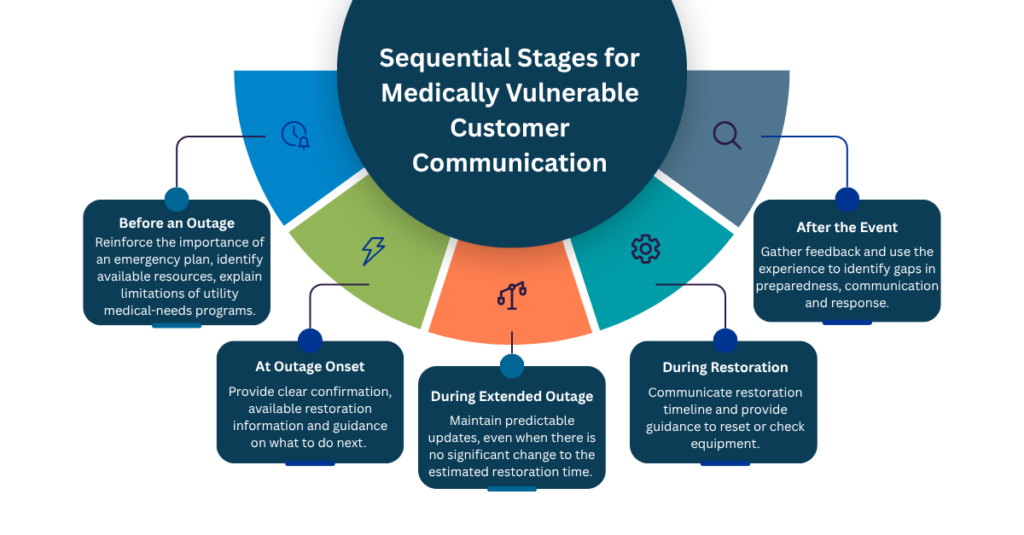
For medically dependent customers, the value of communication1 changes dramatically during an outage. A generic outage notification may not provide enough information for someone whose medical equipment depends on electricity. Customers may need to know whether an outage is confirmed, what the utility knows about restoration, when the next update will arrive and what actions they should consider taking if power will be unavailable for an extended period.
That means utilities should think about communication cadence and content1, not simply whether a notification was sent. The objective is to reduce uncertainty at the moments when uncertainty can be most stressful.
One program cannot do it alone
Supporting medically dependent customers also highlights the importance of breaking down organizational silos. Customer care may own the medical registry. Operations may manage outage restoration. Communications may manage notifications. Emergency management may coordinate community response. Government or external affairs teams may work with local agencies and emergency organizations.
The customer, however, experiences none of those boundaries. That makes medically dependent customer support an excellent use case for cross-functional journey mapping. Bringing the right teams together can reveal gaps that are difficult to see from within a single department. It can also clarify ownership when a situation moves beyond a normal customer interaction and becomes an emergency.
The same principle applies to community partnerships. Healthcare organizations, emergency management agencies, social service organizations and community-based groups may each have a different piece of the customer relationship. Coordinating those relationships can extend the utility’s ability to reach and support customers before, during and after an emergency.
Measure resilience, not just enrollment
Enrollment numbers are useful, but they do not tell the full story. Utilities can consider adding measures that evaluate the effectiveness of the overall customer experience, such as percentage of medical registry records with current contact information, successful delivery of critical outage communications, percentage of registered medically dependent customers successfully reached during extended outages or customer understanding of available preparedness resources.
These measures help utilities determine whether the program is simply functioning administratively or actually helping customers become more prepared and resilient.
Designing for the customer behind the account
The most important shift may be recognizing that a medically dependent customer is not simply an account with a special designation. There is a person behind that account, often with a complex set of circumstances and very little margin for error when the power goes out. Utilities cannot prevent every outage. They cannot guarantee immediate restoration. But they can make the experience more predictable, more coordinated and easier for customers to navigate.
The opportunity is to move from maintaining a medical registry to building a resilience strategy that connects customer experience, communications, operations, emergency management, data and community partnerships.
That starts by asking a different question. Instead of “How do we manage our medical registry?”, ask “How do we create a safer, more resilient experience for customers who depend on electricity for their health?”
That shift in perspective can help utilities identify opportunities across the entire customer journey and build a support strategy that extends well beyond the registry.
See It in Practice at EMACS
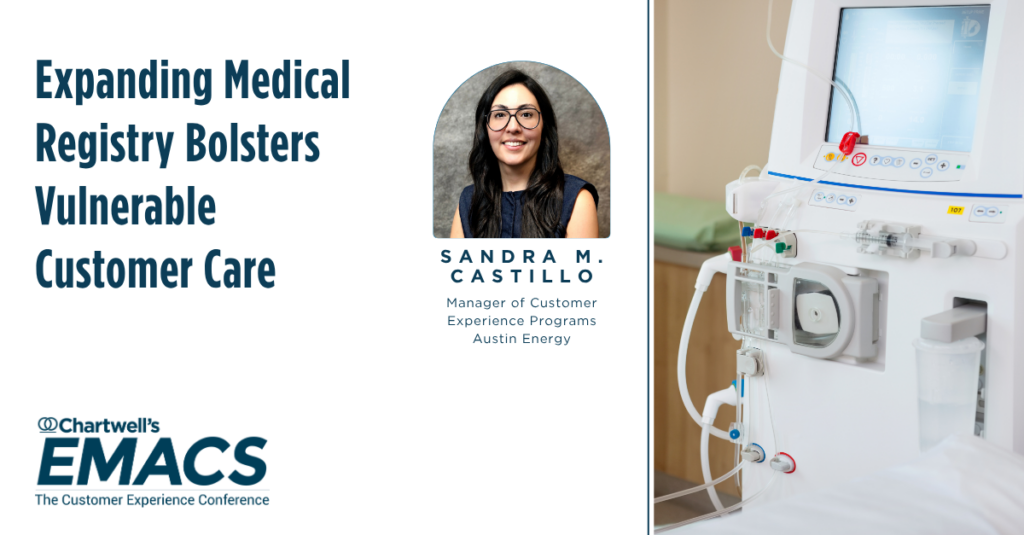
Want to see what this approach looks like in practice? At EMACS 2026, Austin Energy will share how it transformed its Medically Vulnerable Registry into a holistic, customer-centered care program. The utility’s award-winning approach combines digital enrollment, real-time outage verification, automated billing relief, community partnerships, field outreach, individualized case management and portable battery solutions to strengthen preparedness and resilience. Austin Energy received Chartwell’s 2026 Gold Award for Serving Vulnerable Customers, and attendees can hear directly from the utility about its journey and results during the session Expanding Medical Registry Bolsters Vulnerable Customer Care.
Join us at EMACS, September 22–24 in Atlanta, to learn from Austin Energy and other utilities putting innovative customer experience strategies into practice.
1Requires Insight Center Membership | 2Requires Vulnerable Customer Leadership Council Membership
***

Heather Siebken is a product and marketing leader and customer experience expert with more than 25 years of experience driving innovation, customer engagement, and strategic growth. She currently leads councils and marketing at Chartwell, where she designs industry forums and content that help utilities establish a customer experience strategy to navigate customer expectations and digital transformation.
Previously, Heather led product development and marketing at Omaha Public Power District, where she oversaw a broad portfolio of customer energy solutions spanning energy efficiency, demand response, electrification, and customer assistance programs. She is known for her strategic foresight, storytelling, and ability to translate complex trends into actionable business outcomes.
